Cricket id scam warning signs are far easier to learn before money leaves your account than after an “agent” blocks your number. The people selling betting IDs through WhatsApp and Telegram operate with no storefront, no accountability and no refund desk, which makes every claim they make worth questioning. This breakdown maps the full scam lifecycle, the red flags that matter most, and the exact steps to take if you have already paid.
Table of Contents
Why Scammers Sell Cricket IDs on WhatsApp and Telegram
Chat apps give fraudsters everything a scam needs and nothing a customer needs. A WhatsApp number costs almost nothing to set up and even less to abandon. A Telegram channel can broadcast the same promotional message to tens of thousands of people with one tap. There is no shop address, no registered business name and no payment gateway with a dispute button, just a person behind a screen asking you to send money to a personal UPI ID.
The whole cricket ID market runs on this informality. An “ID” is simply a login created on some betting panel and handed over in chat after you pay. Because the entire transaction happens in private messages, there is no public record, no receipt that names a company, and no platform you can escalate to when things go wrong. That structure attracts honest-looking sellers and outright fraudsters in equal measure, and from the outside they look identical.
It is worth saying plainly: everything these IDs connect to involves real money staked on chance, with a built-in house edge, and all of it is strictly for adults 18+. Even when a seller genuinely delivers a login, the risk does not end. It simply moves to the next stage. The frauds described below are a separate, additional layer of loss that happens before a single bet is ever placed.
- Disposable numbers: a blocked SIM is replaced the same day, often with the same display picture and brand name
- Forward-driven reach: promos travel through group forwards, so victims arrive pre-warmed by a friend’s share
- Personal payments: money goes to individual UPI handles or QR codes, not to any traceable business account
- Zero paper trail: nothing is signed, priced in writing or confirmed by email, so disputes become one person’s word against another’s
Understanding the channel matters because it explains why the usual consumer instincts fail here. On a shopping site, a bad seller leaves reviews behind. In a chat app, a bad seller leaves nothing behind at all, so you cannot learn from other people’s experience. The only defence available is inspecting the seller’s behaviour in front of you, which is exactly what the checklist further down does.
The ID-Selling Scam Lifecycle, Stage by Stage
Most victims describe the same sequence, because most fake sellers follow the same script. Learning this sequence sharpens every one of the cricket id scam warning signs that follow: if you can name the stage you are in, you can stop before the next one arrives.
| Stage | What you see | What is actually happening |
|---|---|---|
| 1. Contact | A forwarded promo, group post or status ad promising instant IDs and big bonuses | Mass outreach; the sender does not know or care who you are |
| 2. Trust-building | Friendly chat, “verified” wording in the display name, winning screenshots, customer testimonials | Scripted grooming using recycled or edited images |
| 3. Small win | A tiny ID or demo credit works; a small withdrawal may even arrive | Bait money, treated as a deliberate cost of acquiring you |
| 4. Escalation | Pressure to buy a bigger “premium ID” or deposit more for a bonus | The real target amount is being set up |
| 5. Advance fees | New charges appear: activation fee, processing fee, tax, unlock fee | Classic advance-fee fraud; each payment invents the next |
| 6. Stalling | “Server issue”, “bank delay”, “senior will call you” | Buying time while you stay hopeful |
| 7. Vanishing | Messages go unread, calls fail, you are blocked | The number is retired and the cycle restarts with a new SIM |
The advance-fee stage is where most of the money is lost, not the first payment. Victims who have already sent one amount keep paying invented charges, because stopping would mean accepting that the earlier money is gone. This is sunk-cost pressure, and sellers exploit it deliberately. Every new fee is priced just low enough to feel worth one more try.
Stage three deserves a second look, because it is the stage people remember most fondly and understand least. A small payout early on is not evidence of a working business. It is the cheapest marketing a fraudster can buy, and it is funded by the larger amount they expect from you afterwards. Treat an unexpectedly smooth first withdrawal as information about the script, not about the seller’s honesty.
9 Cricket ID Scam Warning Signs: The Full Checklist
Run any seller against this list before money moves. One match is a caution; two or more is a walk-away signal. These cricket id scam warning signs appear again and again in victim accounts and in public cyber-safety awareness material about chat-app payment fraud.
- Payments to personal UPI IDs, where a name-brand “company” collects on an individual’s QR code, or the payee name is different on every transaction
- Countdown pressure: “offer ends in 10 minutes”, “only 2 IDs left today”, or an instant discount for paying right now
- No verifiable identity: no website that matches the brand, no consistent business name, nothing you could locate after a dispute
- Cloned brand names: handles that imitate well-known panels with one letter changed, a new suffix, or “official” added to the name
- Winning screenshots and testimonials offered as the main proof, since images are free to fabricate and impossible to verify
- Stacked advance fees for activation, processing, tax or unlocking, appearing after you have already paid once
- Requests for Aadhaar, PAN, OTPs or screen-sharing apps, none of which are needed to hand over a login
- Frequently changing numbers, “new number, old number blocked” messages, or a different contact for payment than for support
- Guaranteed-win promises: fixed matches, sure-shot claims or “100% profit” talk, which nobody can honestly offer about outcomes decided by chance
Notice what is missing from the list: politeness, fast replies and professional-looking graphics. Fraudsters are often more responsive than genuine businesses, because responding is their entire job until you pay. Judge sellers on verifiable facts, never on how helpful the chat feels.
The ninth item is the one worth internalising above all others. Cricket results and prediction rounds are uncertain by design, and every platform built on them keeps a structural margin. A person promising a guaranteed outcome is either mistaken about how the maths works or is counting on you being mistaken. Either way, the promise itself is the evidence you need.
Cloned Brands and Lookalike Handles: A Quick Breakdown
Brand imitation is the quiet engine behind most of these losses, because it borrows trust that the fraudster never earned. A reader who has heard a panel name somewhere, from a friend or a forwarded message, will accept a handle that looks roughly right without inspecting it character by character. That is precisely the gap cloned handles are built to fit.
| Imitation trick | How it looks in chat | What to check |
|---|---|---|
| Character swap | A single letter, digit or dash altered in a familiar name | Compare the spelling character by character, slowly |
| Authority words | “Official”, “HQ”, “Admin” or “Support” bolted onto the name | Decoration in a display name proves nothing at all |
| Borrowed artwork | The real brand’s logo as a profile picture | Any image can be downloaded and reused in seconds |
| Mismatched payee | Brand name in chat, unrelated personal name on the UPI screen | Read the payee name on the payment screen before confirming |
| Inflated member count | A channel showing huge subscriber numbers | Member counts can be padded and say nothing about payouts |
The payee mismatch deserves the most attention, because it is the one check a fraudster cannot style their way around. Your payment app shows you the registered name attached to the UPI ID before you confirm. If that name has nothing to do with the brand you are talking to, you have learned something concrete, and no explanation offered in chat should outweigh what the payment screen says.
Lookalike handles also travel in clusters. If a brand name surfaces several near-identical channels with slightly different spellings, the name is being actively imitated, and being told “this is the real one” from inside one of them is worth nothing.
How Do You Know If a Cricket ID Provider Is Genuine?
The honest answer is that in an informal chat-app market you can never fully verify a seller. You can only reduce risk. There is no public directory in which to look up a WhatsApp number, and no neutral body you can escalate a complaint to. What you can do is test the claims a seller makes and refuse to proceed the moment any test fails.
Start with the money trail. A seller who will not explain, before payment, exactly which platform your ID will sit on, what happens if activation fails, and whose account receives your money has already failed the basic test. Our step-by-step verification process to run before any deposit covers the checks in order, from the payee name on the UPI screen to confirming that the login actually works on the named platform.
Then look at history. Genuine operations tend to keep one number, one brand spelling and one payment identity for long periods, because continuity is how they keep customers. Fraud operations churn through numbers and names, because abandonment is how they escape complaints. The full provider vetting checklist turns this into a printable yes or no sheet you can run in five minutes.
- Ask a specific question with a verifiable answer and watch whether you get a direct reply or a deflection
- Ask what happens if the login does not work, and listen for a concrete remedy rather than reassurance
- Check whether the payment identity, display name and contact number all point to the same person
- Give the seller a reason to wait a day; a deal that cannot survive 24 hours of thinking was never a deal
One caution: passing every check still does not make depositing safe. It only means the seller is probably real. The gambling behind the login remains a chance-based activity in which the odds are structured in the platform’s favour and real money is at risk. A genuine ID is not a safe ID.
Why Fake Providers Show Winning Screenshots
Winning screenshots are the single most common prop in this fraud, and among the clearest cricket id scam warning signs when they arrive unprompted. They work because they answer the exact doubt in your mind, “does anyone actually get paid?”, with something that looks like photographic evidence.
The evidence is worthless, for three reasons. First, balance and payout screens are trivially edited; free apps can change any number on any screenshot in seconds. Second, some sellers screenshot demo wallets, which are practice balances that were never real money. Third, even an authentic screenshot proves only that one bet once won, which is exactly what you would expect from games of chance. Chance produces winners; the built-in margin ensures the platform profits across all players over time.
- Round numbers and freshly cropped images that hide the app’s interface, date or account name
- The same screenshot appearing in several “customer” testimonials under different names
- Payout images used to justify an urgent deposit, because proof and pressure arriving together is a script, not a coincidence
- Balances shown without any matching bank credit, which is the only part that would actually mean something
There is a quieter problem with screenshots too. Even if every image were real, you would still be looking at a selected sample. Nobody forwards a photograph of a losing week, so a feed of wins is not a record of outcomes, it is a filter applied to them. Showing you one winner says nothing about your own expected result.
Treat every screenshot as marketing. If a seller’s strongest argument is an image you cannot verify, the argument has already failed.
Details You Should Never Share With an ID Agent
Handing over a login should require almost nothing from you. The moment an agent asks for identity documents, codes or device access, the conversation has changed from selling to harvesting, and the thing being harvested is no longer your money alone.
- OTPs of any kind, including bank, UPI, WhatsApp and app-login codes; sharing a WhatsApp code hands over your entire account
- Aadhaar or PAN images, or their numbers
- Bank passwords, UPI PINs, card numbers or CVVs
- Remote-access or screen-sharing apps such as AnyDesk or TeamViewer, installed “for support”
- Selfies holding your ID card, which complete a kit used for impersonation and fraudulent account opening
Can a cricket ID seller ask for your Aadhaar or PAN card?
They can ask, and many do, but there is no sound reason for a chat-app seller to hold your government identity documents. Creating a login needs a name and a mobile number at most. Leaked identity documents feed a long tail of harm: SIM cards issued in your name, mule bank accounts, loan applications and impersonation that surfaces months later. Refuse, and treat the request itself as a terminal red flag.
If you have already shared documents, the damage is not automatic, but it is worth monitoring. Watch for unexpected SMS about accounts or loans you did not open, keep an eye on your credit record, and preserve the chat in which the documents were requested. Knowing when and to whom they were sent is the detail that makes any later report useful.
OTP theft deserves special attention, because it is how accounts and wallets are emptied in minutes. Fake “support agents” commonly call after a payment issue, claiming they need a code to “release” funds. The dedicated breakdown of OTP fraud protection for gaming accounts explains how these calls are scripted and what to do in the first minutes after a code is shared.
Agent Not Responding After Payment? Do This First
Silence after payment is the vanishing stage of the lifecycle, and the first hour matters most. Banks and payment intermediaries can sometimes freeze fraudulently received money before it is moved onward, but only if the report reaches them quickly. Work through these steps in order rather than all at once.
- Stop paying immediately. No release fee, re-activation charge or “verification deposit” will revive the deal; each one is a second fraud on the same victim.
- Preserve evidence before you are blocked: export the full chat, screenshot the profile, and note every phone number, UPI ID and QR code used.
- Find your transaction references, which means the 12-digit UTR for each UPI payment, with dates and amounts, from your payment app or bank statement.
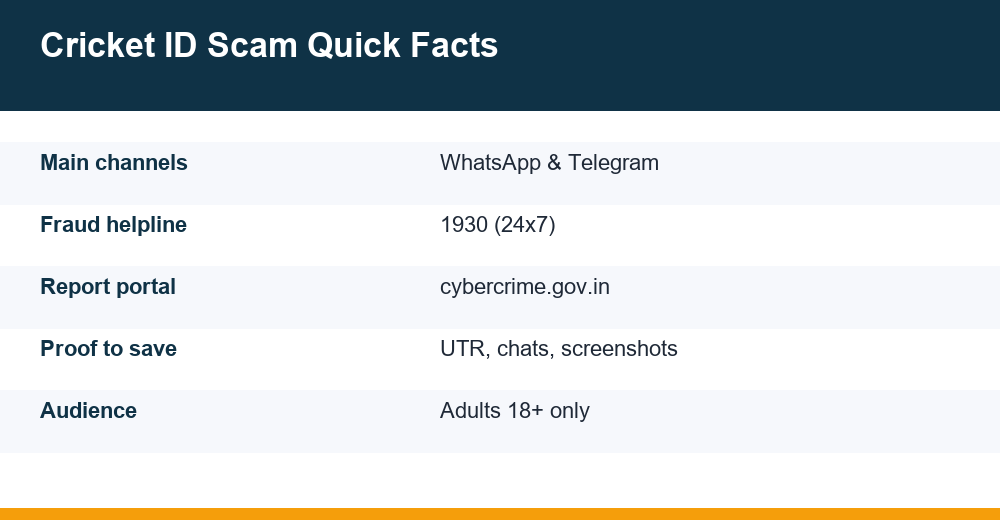
- Call 1930, the national cyber fraud helpline, as soon as possible; it runs around the clock and starts the fund-tracing workflow.
- File the written complaint on the National Cyber Crime Reporting Portal, attaching your UTRs, chat export and screenshots. Published portal instructions say a helpline report should be completed online within 24 hours.
- Inform your bank or UPI app through its official fraud channel, so the transactions are flagged on their side as well.
Keep one written record of what you did and when, including the acknowledgement or complaint number from each channel. Fraud reports pass between the portal, the police and more than one bank, and the reference numbers are what let anyone pick the case up later without starting from your memory of events.
Two warnings for the days that follow. First, ignore anyone who contacts you offering to “recover” your money for a fee; recovery agents who find victims rather than the other way around are running the follow-up fraud, since genuine recovery only ever flows through your bank and the official reporting process. Second, be realistic. Recovery is possible when reports are fast, but it is never guaranteed, and reporting still matters because it blocks the accounts used on the next victim.
Where to Get Help and Report
Keep these contacts saved before you ever need them. Speed is the difference between a frozen account and an empty one, and knowing the right first call removes the panic decision at the worst possible moment.
- 1930, the national cyber fraud helpline for financial fraud, available 24×7
- The National Cyber Crime Reporting Portal, for the written complaint with your evidence attached
- Your bank or UPI app’s own fraud reporting channel, reached through the app or the number printed on your card, never a number received in chat
- Tele-MANAS on 14416, the Health Ministry’s free, round-the-clock mental health helpline, if losses or gambling pressure are affecting you; support exists in multiple languages and asking for it works
A final word on prevention. Every stage of this fraud depends on urgency: the limited offer, the expiring bonus, the agent who needs the fee right now. Genuine opportunities survive a day of thinking; fraud cannot. Slowing down is not a technique so much as the entire defence. Read the checklist again, run the verification steps, and let any deal that punishes patience disqualify itself.
Frequently Asked Questions
How do I know if a cricket ID provider is genuine?
You can never fully verify a chat-app seller; you can only reduce risk. Check that the payee name, brand name and contact number stay consistent, that the seller names the platform and remedy terms before payment, and that no advance fees appear. Long-standing numbers and one payment identity are better signs, but a genuine seller still connects you to chance-based gambling with real money at risk.
Why do fake providers show winning screenshots?
Screenshots answer the doubt every buyer has, whether anyone gets paid, with images that cost nothing to fabricate. Balances are edited with free apps, demo wallets are passed off as real money, and single wins are cherry-picked. Even an authentic win proves nothing about your expected outcome, because games of chance always produce some winners while the built-in margin favours the house.
Can a cricket ID seller ask for my Aadhaar or PAN card?
There is no sound reason for a WhatsApp or Telegram ID seller to hold your government identity documents, since creating a login needs only a name and mobile number. Leaked Aadhaar or PAN details can be misused for SIM cards, mule bank accounts and loan applications in your name. Treat any document request from a chat-app agent as a decisive warning sign and refuse.
What should I do if an ID provider stops responding after payment?
Stop paying immediately, because no release fee will revive the deal. Export the chat, screenshot the profile, and note every number, UPI ID and 12-digit UTR. Call the 1930 cyber fraud helpline as fast as you can, then complete the written complaint on cybercrime.gov.in with your evidence, and inform your bank. Fast reporting can freeze funds, though recovery is never guaranteed.