Seeing a withdrawal blocked message is where the panic usually starts, because the screen says almost nothing while the balance sits out of reach. This page sets out what the different kinds of holds actually mean, how the deposit-to-unlock pressure sequence unfolds, and what to do instead of chasing the money. One plain note first: these games are chance-based with a built-in house edge, real money is at risk, and they are for adults 18 and over only.
Table of Contents
Withdrawal Blocked: What It Actually Means
The wording on screen is always short – blocked, on hold, under review – and the explanation is almost always missing. In practice a withdrawal blocked status covers at least four very different situations, and the right response depends entirely on which one you are in: a routine document check, a bonus condition you did not notice, a bank detail that does not match, or a platform that has quietly stopped paying anyone at all.
Telling them apart starts with knowing that a payout is not one action. Money moves through several hand-offs, and a hold can sit at any of them. Only the last stage involves a bank; everything before it is controlled entirely by the platform, which is also why the platform stages are the ones described least clearly.
- Wallet balance: funds inside the app, held by the platform until paid out
- Withdrawable balance: the portion free of bonus or turnover locks
- Payout instruction: the transfer order the platform sends to a bank or UPI channel
- Settlement: the bank-side step that actually credits your account
If you are unsure what the normal sequence looks like, our breakdown of colour prediction withdrawals walks through the ordinary request-to-credit pipeline. Compare what you are seeing against that baseline. A delay that fits the published window is operations; a hold with shifting explanations and new payment demands is something else.
Keep one structural fact in view throughout. Every round is independent chance with a margin built into the payouts, so the balance on screen is not savings being withheld from you – it is an amount an operator has recorded in its own ledger. That distinction matters when you decide how much more time, and money, to spend pursuing it.
Why Is a Payout Pending for Days?
Pending is the most common status and the least informative. A small set of causes explains the large majority of stuck requests, and they are worth working through in order of likelihood before assuming the worst.
- Incomplete verification: documents not submitted, or submitted and not yet approved
- Name mismatch: the bank or UPI account name differs from the registered profile name
- Unmet bonus turnover: promotional credit locked the balance until wagering conditions cleared
- First payout review: many apps inspect a user’s first withdrawal manually
- Amount outside limits: below the stated minimum or above a daily cap
- Duplicate requests: cancelling and re-raising repeatedly resets the queue position
- Batch timing: some payment desks release payouts only at fixed hours
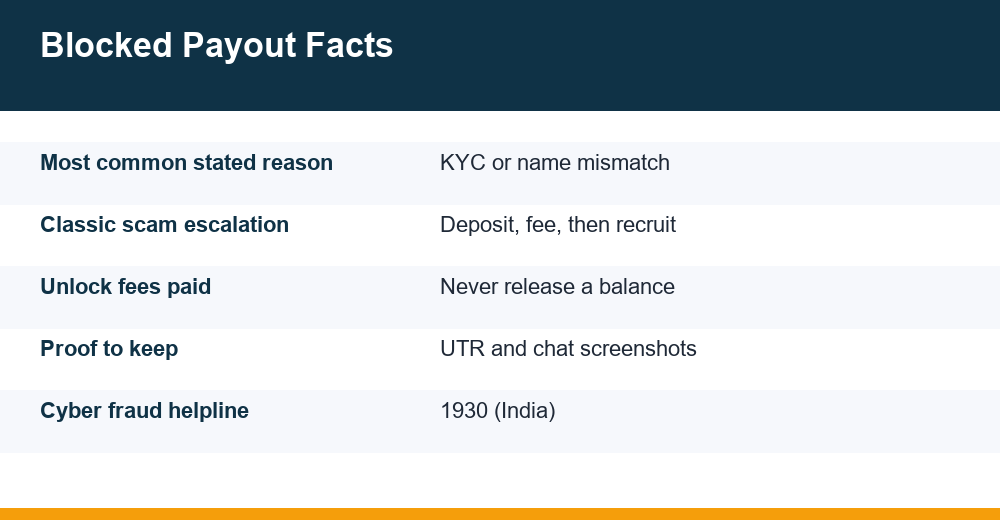
Most of that list is administrative rather than sinister, and a hold that clears inside the stated window is normal. What matters is the pattern over several days. If support gives you a specific, checkable reason and the request moves once you fix it, the system is working. If each reply gives a new reason and nothing ever moves, you are not in a queue.
There is also a timing detail worth noting. Holds appear far more often after an unusually large deposit or an unusually large win than during ordinary small play. That skew is one of the clearest early signals in complaint threads, and it is the point at which to slow down rather than deposit again.
Why an App Asks for Another Deposit to Unlock a Payout
Because it works. A user with a frozen balance is already emotionally invested, and a small extra deposit feels cheap next to the amount apparently waiting. The demand is usually dressed up in operational language: a wallet activation, a tier upgrade, a minimum turnover top-up, a “matching” deposit to confirm the account is genuine.
None of those are real payment mechanics. A payout instruction does not need an incoming deposit to execute, and no bank or UPI channel requires the recipient to send money before receiving money. When a platform ties your existing balance to a new payment from you, the balance has become the hook rather than the obligation.
The sequence in reported cases is remarkably consistent, which is what makes it recognisable. A first hold with a plausible reason. A modest deposit to clear it. A larger demand framed as a fee. Then, often, an invitation to recruit friends or move to a “VIP” channel where the payout supposedly happens faster. Each step raises the sunk cost and the reluctance to walk away.
- Deposit requested specifically to release an existing balance
- Thresholds that move upward each time you reach them
- Support shifting from in-app chat to WhatsApp or Telegram
- A named “manager” or “agent” handling your case personally
- Payment requested to a personal UPI ID or individual account
- Promises of priority processing in exchange for recruiting others
One related confusion is worth separating out: a deposit that genuinely never arrived is a different problem with a different fix, and we cover it in our notes on a deposit not credited. Mixing the two up is common, and it gives a stalling operator room to blame the bank for something that never left its own ledger.
Should You Pay a Fee or Tax to Release Winnings?
No. Not a processing charge, not a verification fee, not a clearance payment, not a “tax deposit” to be refunded later. A payment demanded as the condition for releasing your own balance is, in every reported pattern, the second half of the same scam rather than a step toward a payout. Paying it almost never produces money; it produces a new demand.
The framing is deliberately bureaucratic because bureaucracy sounds unavoidable. It also exploits a real asymmetry: ordinary financial life does involve charges and deductions, so an invented one does not feel absurd. The test is simpler than the vocabulary suggests – a legitimate deduction is taken from the amount being paid, never collected from you in advance through a separate channel.
| What you are told | How it is framed | What it actually is |
|---|---|---|
| Pay a processing fee | Bank charges for large transfers | Money collected outside the payout |
| Deposit to activate wallet | Account confirmation step | A new deposit, not a release |
| Tax clearance payment | Deduction to be refunded later | An advance payment with no refund |
| Upgrade to a higher tier | Faster payout queue | Escalating demand on the same balance |
| Recruit users to qualify | Loyalty or referral condition | Pressure to involve other people |
The entries above describe how these demands are typically worded in complaints, not an official schedule of anything. Treat the middle column as sales language and the right-hand column as the function it serves. Once a release payment enters the conversation, the useful question stops being how to get the balance out and becomes how to stop the loss where it stands.
Recruiting deserves its own line. Being asked to bring in friends or family to qualify for a payout turns a personal loss into other people’s losses, and it is the point at which walking away protects more than your own money.
Six Steps When a Withdrawal Blocked Status Will Not Clear
When the obvious administrative fixes are done and nothing has moved, work through a fixed sequence rather than improvising. The order matters: it preserves evidence before anyone has a reason to delete it, and it stops the escalation before it costs more.
- Stop depositing. Freeze your own outflow before doing anything else, whatever the app is promising.
- Capture the current state. Screenshot the request, the status, the balance and the transaction history today.
- Ask support, in writing, for one specific thing: the exact reason and the exact step needed. Keep the reply.
- Fix only genuine details once – a name spelling, an account number, a UPI ID – and resubmit a single request.
- Check your own bank statement to see whether any credit, reversal or partial payment actually arrived.
- If nothing moves and new payments are demanded, switch from recovery mode to reporting mode.
Step six is the one people resist, because it feels like giving up on the balance. In practice it is the step with the best odds attached: reporting early, while any funds may still be traceable, does more than weeks of chat messages. Chasing a withdrawal blocked notice through the same support channel that created it rarely changes the outcome.
Resist the urge to open a second account, use a relative’s bank details, or try a different device. All three are treated as red flags by payment teams, and they give a platform a defensible reason to keep the hold in place.
What Evidence to Collect and Preserve
Complaints fail far more often for lack of documentation than for lack of merit. Whoever reviews your case – a bank, a payment app, a police cyber cell – needs to see exactly what happened, in what order, and with which account. Ten minutes of collection beats ten angry messages.
- The withdrawal request itself: amount, date, time and the status shown
- The full transaction history page, not a single entry
- Any UTR or reference number displayed for a claimed transfer
- Every support conversation, including agent names, numbers and promises made
- Screenshots of any fee, deposit or unlock demand, with the payment details given
- The app version, the exact website address, and the account or UPI ID used
- Your own bank statement entries covering deposits and any reversals
Export rather than rely on the app. Accounts get closed, chats get cleared and apps get pulled from stores, and anything held only inside the platform can disappear without notice. Save screenshots to your own device or cloud storage, and note the date on each one.
Record the names and numbers used by anyone who contacted you outside the app. Those details are frequently the most useful part of a report, because the same personal accounts and handles turn up across many unrelated complaints.
Who to Complain To When an App Will Not Pay Out
Route the complaint by where the failure actually sits, because sending it to the wrong place costs days. There are three broadly different situations and they go to three different places.
- The payment leg failed: your money left but did not arrive, or a transfer bounced – start with your payment app and bank
- The platform claims it paid: ask for the UTR and have your bank trace that reference
- The platform refuses to pay, or demands a release payment: treat it as suspected payment fraud and report it
For a UPI transaction that genuinely failed or was not credited, the first-line route runs through your own UPI app and bank, with a defined escalation path behind it. NPCI publishes how that works in its UPI dispute redressal mechanism, and it is worth reading before you contact anyone, so you arrive with the right reference numbers in hand.
Where money was taken through a release payment, a fee demand or a personal account transfer, speed matters more than completeness. In India, call the national cyber fraud helpline 1930 as soon as you realise what has happened, then file the detailed complaint with your evidence on the government portal at cybercrime.gov.in. Reporting quickly improves the chance that funds are still traceable; waiting for one more support reply usually does not.
Our walkthrough on how to report online gaming fraud sets out what each channel asks for and the order to approach them in. File once, properly documented, rather than several times in fragments.
Red Flags and When to Stop Chasing the Balance
Some signals are strong enough, on their own, to end the relationship rather than prompt another attempt. The clearest is directional: deposits work flawlessly every time while every payout fails for rotating, vague reasons. A payment setup that can reliably pull money in can reliably push it out. When only one direction ever functions, the problem is intent, not infrastructure.
- Minimums or limits that rise exactly when you try to cash out
- Documents demanded repeatedly, or demanded through chat apps rather than in-app
- Any payment tied to the release of an existing balance
- Support that only works through a personal number or a single named agent
- Account closed or chats cleared shortly after you raise a complaint
- Pressure to recruit others as a condition of being paid
None of that makes any specific named app anything in particular – these are patterns to weigh, and the judgement is yours. But the practical maths is unkind. Each additional deposit made to recover a blocked amount increases the loss with no mechanism that would reduce it, because nothing about depositing changes whether a platform intends to pay.
Draw the line in advance and in writing: no release payments, no new deposits after a hold, no recruiting. Then shift your effort from recovery to documentation and reporting, which is where the remaining leverage actually is.
If a stuck balance has you depositing money you cannot afford to lose, or losing sleep over it, that is worth treating as seriously as the money. Free, confidential support exists: in India, the Tele-MANAS helpline on 14416 operates around the clock in multiple languages. Reaching out early is a practical step, not an admission of anything.
Frequently Asked Questions
Why is my withdrawal pending for days?
Usually for an administrative reason: verification still under review, a name mismatch between your profile and bank account, unmet bonus turnover, a first-payout check, an amount outside the limits, or fixed batch processing times. Work through those in order. A hold that clears inside the stated window is routine; one with a new explanation every day is not.
Why does an app ask for another deposit to unlock a withdrawal?
Because the demand works, not because payments require it. No bank or UPI channel needs the recipient to send money before receiving money, so a deposit tied to releasing an existing balance is a pressure tactic. It typically starts small, then escalates into larger fees. Stop depositing, document the demand and report it.
Should I pay a fee or tax to release my winnings?
No. Genuine deductions come out of the amount being paid; they are never collected from you in advance through a separate channel. Processing fees, activation deposits and tax clearance payments demanded to free a balance almost always produce a fresh demand rather than a payout. Treat the first such request as the stopping point.
What evidence should I collect when a withdrawal is blocked?
Screenshot the request with amount, date, time and status, plus the full transaction history. Save every support chat, agent name and payment demand, any UTR shown, the app version and website address, and your own bank statement entries. Export it all to your own device, because accounts and chat logs can disappear without notice.