If an app has taken your money and gone quiet, the fastest way to report online gaming fraud in India is a phone call, not a forum post. This walkthrough covers the golden hour, the 1930 helpline, filing on the national cybercrime portal, the evidence to collect before you start, and what realistically happens afterwards. It is awareness information for adults aged 18 and above.
Table of Contents
Why Gaming Payment Fraud Needs Its Own Route
Most advice about recovering money after online fraud is written for a different kind of crime. Card skimming, OTP theft and SIM-swap cases involve money leaving an account without the owner’s knowledge. Gaming-payment fraud is the opposite: you authorised every transfer yourself, usually in instalments, often to a different destination each time. That difference changes what you need to collect and how you describe it.
It also changes the shape of the loss. A single unauthorised debit is one transaction with one timestamp. A frozen payout or a vanished app is typically a chain of small deposits spread over days or weeks, tangled up with chat messages, referral links and a balance shown on a screen you never controlled. Specifics are what move a complaint, so the chain has to be reconstructed first.
- Every transfer was authorised by you, so no bank alert flagged it in advance.
- Payments often went to several UPI IDs, QR codes or agent accounts rather than one merchant.
- The website, app name or group chat may already have changed or disappeared.
- The balance you were shown was a number inside the operator’s own system, not money held for you.
- Deposits sit mixed in with ordinary spending in your statement, so each one needs identifying.
If you are reading this before anything has gone wrong, the recruitment and pressure patterns are worth knowing in advance. Our breakdown of cricket ID scam warning signs covers the approaches that almost always come before a payment problem.
The Golden Hour: Why the First Minutes Decide So Much
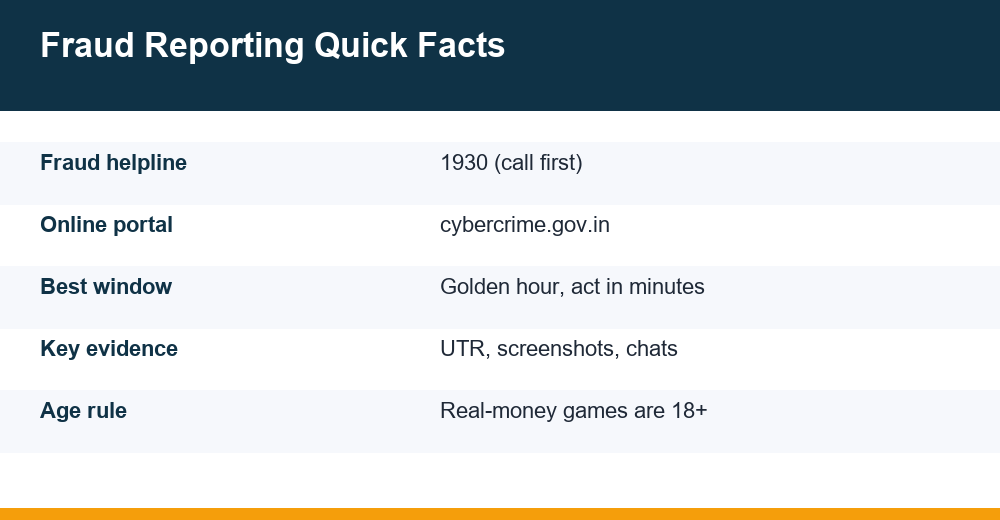
In cyber fraud reporting, the “golden hour” describes the short window immediately after money leaves your account, while a report still has a realistic chance of catching the funds before they move on or are withdrawn. Public advisories describe it slightly differently — some say the first hour, others the first one to two hours after the debit — so treat any specific figure as illustrative rather than a hard deadline.
The mechanism behind the urgency is straightforward. When a financial cyber fraud is reported, the complaint is passed to the bank or payment provider that received the money so the suspected amount can be placed on hold while it is examined. That only works while the money is still somewhere in the system. Once it has been moved through several accounts or cashed out, there is nothing left to hold.
Speed beats completeness. A rough report made in twenty minutes is worth more than a polished one filed next week, which is why people who report online gaming fraud immediately tend to fare better than those who spend days assembling paperwork. Call first with whatever you have, then add the detail in your written complaint.
- Stop every further payment. Decline pending collect requests and pay no “release”, “tax” or “unlock” charge.
- Note the last transaction: amount, time, and the UPI ID or account it went to.
- Call 1930 and report the loss, even with only partial details to hand.
- Screenshot the app, the wallet balance and the payout request before anything is deleted.
- Contact your bank or payment app so the transfers are flagged on their side as well.
Evidence First: The Details You Need Ready
The question people ask most is what details you need to report online gaming fraud properly. The short answer: anything that ties a rupee amount to a timestamp and a destination. A complaint saying an app cheated you goes nowhere; dated transactions with reference numbers give someone a trail to follow.
Build the file before links start dying. Operators rotate domains, rename apps and delete group chats quickly, and a screenshot you did not take is usually impossible to recover later.
| Evidence | Where to find it | Why it matters |
|---|---|---|
| UTR of every transfer | UPI app history or bank statement | Uniquely identifies each payment for tracing |
| Destination UPI IDs or accounts | Payment confirmation screens | Shows where the money actually went |
| Withdrawal request screenshots | In-app wallet or payout history | Records that you asked and were refused |
| Chat logs with agents | Exported WhatsApp or Telegram threads | Captures demands and promises with timestamps |
| App name, version and web address | Browser address bar or app info screen | Platforms switch domains to shed complaints |
| Dated summary of amounts | Your own note or a simple spreadsheet | Lets you report quickly and consistently |
Export chats rather than screenshotting them, because exports preserve timestamps and sender details. Keep payment receipts unedited too; cropped or annotated images carry less weight as supporting material than the originals do.
One check is worth doing first: confirm the problem really is fraud and not a stuck transfer. Money that left your bank but never reached the app has its own set of fixes, covered in our explainer on a deposit not credited to a gaming wallet.
How to Report Online Gaming Fraud Step by Step
There are three channels, and they are not alternatives. Use all three, in this order, because each one does something the others cannot.
- Call the 1930 helpline and report the financial loss straight away.
- File the written complaint on the national cybercrime portal with your evidence attached.
- Notify your bank or UPI provider separately so the destination accounts are flagged on their side.
What is the 1930 cyber fraud helpline?
1930 is India’s dedicated helpline for reporting financial cyber fraud, run under the Indian Cyber Crime Coordination Centre. The call is where the clock starts: your report is registered and a hold request can be sent onward to the bank or payment service that received the money. Keep the last transaction details and your own account number in front of you before dialling.
Nobody from 1930 will ever ask for an OTP, UPI PIN or password. A caller who does is running a second fraud on top of the first. Write down the reference number you are given before the call ends, and dial only the short code itself rather than any “helpline” number forwarded to you in a chat group.
How do I file a complaint on the cybercrime portal?
The written complaint goes to cybercrime.gov.in, the Government of India’s portal for reporting cybercrime online. Reporting a financial fraud means registering with a mobile number and verifying it by OTP, then entering the incident details, the transaction information and your uploaded evidence. Complaints are handled by the authorities in the state you select, and you receive an acknowledgement number for tracking.
- Choose the route for reporting other cybercrimes and register with your mobile number.
- Enter the incident details: dates, amounts, platform name and how you were first approached.
- Add each transaction individually with its UTR, amount, date and destination identifier.
- Upload the evidence file — screenshots, statements and exported chat logs.
- Save the acknowledgement number and a copy of the submitted complaint.
The portal publishes its own instructions for citizens reporting financial fraud, including the information to keep ready before you start; that document sits on the national cybercrime portal. Filing costs nothing, and the acknowledgement number lets you check progress later.
Should You Also Inform Your Bank or UPI App?
Yes, and as a separate action rather than an afterthought. The helpline and the portal work through one channel; your bank and payment app work through another. Telling them that the accounts you paid are linked to a suspected fraud lets them flag the transfers on their side and explain what their own dispute process allows in your case.
Use the bank’s official number from your passbook, card or app — never a number sent to you in a group or by an “agent”. Fake recovery agents are a known follow-up scam aimed squarely at people who have just lost money and are searching for help.
- Report through the registered helpline, your branch, or the official in-app complaint form.
- Give the date, amount and UTR of every disputed transfer, not just the largest one.
- Ask for a written complaint reference rather than a verbal assurance.
- Mention that you have already reported to 1930 and filed on the cybercrime portal.
- Refuse any offer to recover funds in exchange for an advance fee.
If the money left after you approved a payment request that appeared on your phone, rather than a transfer you started yourself, read our note on the UPI collect request scam first. Being able to describe exactly what you approved, and when, makes the conversation with your bank far shorter.
After You File: Tracking and Realistic Expectations
Once you report online gaming fraud, the acknowledgement number becomes your handle on the case. Keep it alongside the evidence file, and store both somewhere other than the phone the app was installed on, in case that device has to be reset.
Can you get your money back after reporting a fraud?
Sometimes, partly, and realistically only when the funds were caught before being moved on. Reporting is what makes a hold possible; it does not make one certain. The outcome depends on how fast the report went in, whether the receiving account still held anything, and what the examination that follows concludes. Treat recovery as a possibility, never as a plan.
Expect follow-up contact rather than instant resolution, and expect to supply the same transaction details more than once. Keep every communication and reply promptly when clarification is requested, because unanswered queries are where complaints go quiet.
There is a second reason to file even when recovery looks unlikely. Reports are how repeated destination accounts, recycled domains and agent networks get mapped. A complaint that does nothing for your own loss can still shorten the life of the operation that caused it.
Common Mistakes That Weaken a Complaint
Most complaints that stall do so for predictable reasons. Running through this list before you file is usually quicker than fixing the gaps afterwards.
- Paying an “unlock”, “tax” or “verification” charge in the hope of releasing a balance.
- Waiting days to gather perfect paperwork before making the first call.
- Uninstalling the app or leaving the group chat before exporting the evidence.
- Reporting one transaction when there were fifteen, leaving most of the loss unrecorded.
- Trusting a “recovery expert” who makes contact after you post about the loss publicly.
- Sending a stream of angry messages to support instead of one factual written complaint.
- Describing the loss only in general terms, with no amounts, dates or reference numbers.
The pattern behind most of them is understandable and expensive: chasing the balance instead of closing the tap. Money sent after you realise something is wrong rescues nothing; it is simply a second loss stacked on the first, and it is money the reporting process cannot help you with either.
Closing the Tap and Looking After Yourself
With the evidence saved and the reports filed, remove the pressure channels. Leave the groups, block the agents, and uninstall the app after — not before — you have your screenshots. Cancel any autopay mandate or standing payment permission you set up for deposits, then read through your statement for recurring debits you no longer recognise.
Change the password on any account that shared credentials with the platform, particularly if you reused a banking or email password. Treat any “refund” or “compensation” message arriving in the following weeks as a fresh approach rather than good news; lists of people who have already lost money are traded and reused.
It is worth saying the plain part plainly. These are chance-based games with a built-in house edge, real money is genuinely at risk every round, and they are for adults aged 18 and over only. No reporting process changes those odds, and nothing sold in a chat group beats them either.
If the loss has left you anxious, in debt, or unable to stop thinking about winning it back, support exists. Tele-MANAS, the government’s free mental health helpline, can be reached on 14416 and operates around the clock in multiple languages. Talking it through with someone is a stronger next step than another deposit, every single time.
Frequently Asked Questions
What is the golden hour in cyber fraud reporting?
The golden hour is the short period right after money leaves your account, when a report can still reach the receiving bank before the funds are moved on. Advisories describe it as roughly the first hour or two after the debit, so treat the timing as illustrative. Practically, report within minutes rather than waiting to gather complete paperwork.
What details do I need to report online gaming fraud?
Have the UTR of every transfer, the destination UPI IDs or account numbers, dated screenshots of your wallet and withdrawal requests, the platform’s exact app name and web address, and exported chat logs with any agent. Add a simple dated summary of amounts. Unedited originals with visible timestamps carry considerably more weight than cropped images.
Can I get my money back after reporting a fraud?
Sometimes, and only partly. Reporting quickly makes it possible for the receiving bank to place suspected funds on hold, but nothing is guaranteed once money has been moved through several accounts or withdrawn. Outcomes depend on timing and what the examination finds, so treat recovery as a possibility rather than an expectation.
Should I also inform my bank or UPI app?
Yes, as a separate step from the helpline and the portal. Your bank can flag the disputed transfers and tell you what its own dispute process covers. Always use the official number printed on your passbook, card or app, never one shared in a chat group, and refuse anyone offering recovery for an advance fee.