
The KYC documents gaming apps ask for – Aadhaar, PAN, bank proofs, selfies – are the same documents a fraudster needs to open loans and mule accounts in your name. Most search results on this topic come from verification-software vendors rather than from anyone trying to protect the person uploading the file. This breakdown covers which requests fit a normal pattern, which ones should stop you cold, and what to do if your documents are already out there.
Table of Contents
Why Gaming Apps Ask for Aadhaar or PAN
KYC stands for Know Your Customer – the identity check a business runs before it lets you move money in or out. On a real-money platform the stated purpose is usually threefold: confirming you are a real, single person rather than one of twenty duplicate accounts, confirming you are an adult, since real-money play is 18+ only, and matching the bank account you withdraw to with the identity you registered under.
The KYC documents gaming apps collect fall into two baskets. Identity proof – normally Aadhaar or PAN – establishes who you are and your age. Payment proof – a bank statement header, a cancelled cheque, or a UPI handle confirmation – establishes that payouts land in an account carrying your own name, which is a basic anti-fraud control rather than a formality.
It is worth knowing what each document gives away. An Aadhaar copy carries your name, photograph, date of birth and often your address in one file. A PAN copy ties you to a permanent financial identity you can never rotate the way you rotate a password. A bank proof adds an account number and, with a careless crop, a transaction history nobody asked for. Sensitivity is not equal across the three, so neither should your caution be.
That is the theory. The problem is that an identical-sounding request can come from two very different senders: a structured app with a published privacy policy and an in-app upload field, or an anonymous operator on WhatsApp who stores your Aadhaar in a phone gallery and a few forwarded chats. The document is the same; the exposure is not remotely the same.
One thing deserves stating plainly before any document enters the picture. Every game of chance on these platforms carries a built-in house edge, outcomes cannot be predicted or steered, and money you deposit is genuinely at risk. Verifying your identity does nothing to improve those odds – it only widens the circle of people who know exactly who you are.
KYC Documents Gaming Apps Request: Normal vs Risky
Not every request deserves the same answer. The KYC documents gaming apps genuinely need are a narrow set: one identity proof and one payment proof, uploaded inside the app itself, at a predictable moment – usually before your first withdrawal. Anything outside that pattern should slow you down rather than hurry you up.
| Request | Typical context | Risk signal |
|---|---|---|
| Masked Aadhaar or PAN via in-app upload | Before first withdrawal | Normal if the app has a privacy policy and a support channel |
| Selfie or liveness check inside the app | Age and identity match | Common; confirm it never leaves the app |
| Bank proof for the withdrawal account | Matching payout account to your name | Normal; share only the page showing name and account |
| Full Aadhaar photo sent on WhatsApp or Telegram | Chat-based ‘ID agent’ | Dangerous – no custody, no accountability, no deletion |
| Aadhaar OTP read out to an ‘agent’ | Caller offers to ‘complete KYC for you’ | Never legitimate; an OTP authorises actions in your name |
| Documents demanded before any deposit or play | Account barely created | Suspicious – a harvesting pattern, not a verification one |
| Passport, voter ID and PAN together | ‘Verification failed, send more’ | Escalating demands are a classic data-collection tactic |
Timing is the most reliable tell. Genuine checks cluster around withdrawal, because that is the point where money leaves the platform and identity actually matters. Harvesting requests cluster at signup, arrive over chat apps, and escalate step by step: first PAN, then Aadhaar, then a selfie holding the card. No ordinary verification process needs a photograph of you holding your Aadhaar up to your face for a gaming account.
The second tell is the channel. An upload field inside an app creates a record and a responsible party you can write to. A WhatsApp chat creates neither – the file simply sits in someone’s phone, forwardable in a single tap, with no deletion you will ever be able to verify.
One question settles most cases: what is the smallest version of this document that answers the request – masked instead of full, cropped instead of complete?
Is It Safe to Upload Your PAN Card?
It depends entirely on where the upload lands, so the honest answer is: sometimes, and only with precautions. PAN is a permanent identifier. Unlike a password, you cannot reissue it after a leak and walk away clean. Indian reporting has repeatedly described fraud groups using harvested PAN and Aadhaar copies to apply for instant loans in other people’s names, with victims finding out from a recovery call.
Before any PAN upload, apply the same diligence you would apply to the platform itself. Our verification checklist to run before any deposit covers the platform-level questions; for the document itself, work through these:
- Upload only inside the app or its official website – never over chat, email, or a link somebody sent you.
- Add a visible purpose watermark across the image: the platform name and the date, written diagonally over the card rather than tucked in a corner, so the copy is useless anywhere else.
- Crop or cover anything the request does not need. A PAN check never needs your bank balance, your salary line, or your family details.
- Keep your own record: screenshot the upload screen with the date, so you can later say precisely what you shared and with whom.
- Check your credit report periodically for loan enquiries you never made – that is usually how PAN misuse surfaces first.
- Never send a document twice because ‘the first one did not go through’. Re-requests are a standard pressure script.
If a platform cannot say in writing why it needs PAN, where the file is stored, and how you can have it deleted, that silence is itself the answer. An operator casual about your identity before you deposit will not become careful about your money afterwards.
Masked Aadhaar and Virtual ID, Explained
UIDAI offers two tools that let you prove identity without handing over your full Aadhaar number, and almost nobody collecting your documents will volunteer that they exist. Knowing both changes the balance of the conversation.
Masked Aadhaar
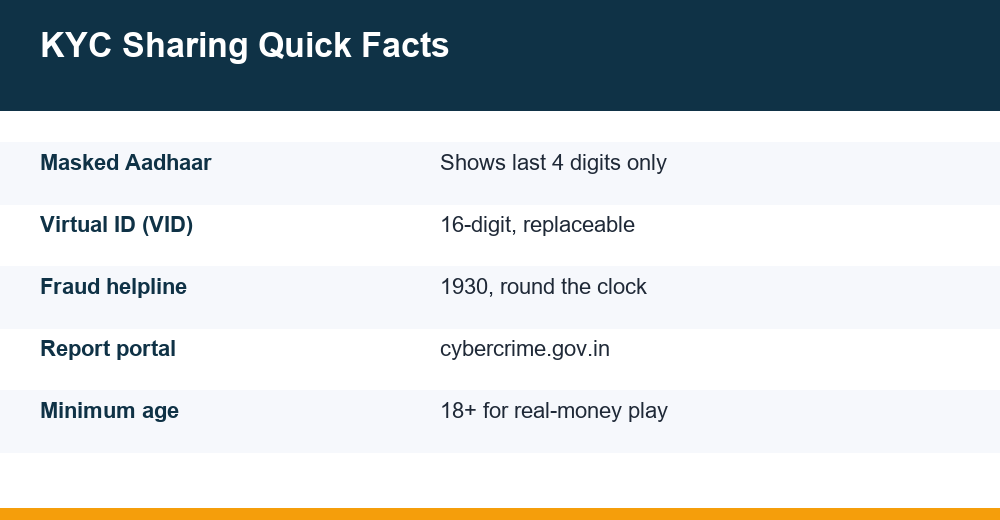
A masked Aadhaar is an official download of your Aadhaar in which only the last four digits of the number are visible; the earlier digits are hidden. It still carries your name, photograph and demographic details, so it works perfectly well as identity and age proof. Crucially, it is issued by UIDAI itself – this is not a do-it-yourself edit with a black rectangle, which a verification team is entitled to reject.
- Open the UIDAI website or the mAadhaar app and choose the Aadhaar download option.
- Select the masked version where the download screen offers it.
- Authenticate with the one-time password sent to your registered mobile number.
- Save the password-protected PDF, and open it to confirm the digits are genuinely hidden before you send it anywhere.
Menu labels change from time to time, so treat the sequence above as the shape of the process and follow whatever the current screen says.
Virtual ID (VID)
A Virtual ID is a temporary 16-digit number mapped to your Aadhaar. Where a service performs Aadhaar-based authentication, you can supply the VID instead of the real number. The Aadhaar number cannot be worked backwards out of a VID, and you can generate a fresh one whenever you like, which effectively retires the old one. Generate it through the UIDAI site or the mAadhaar app, use it, then replace it.
The practical rule is easy to remember. When a platform wants Aadhaar as a document image, send the masked version. When a flow wants the Aadhaar number for authentication, give a VID and replace it afterwards. If a requester refuses a masked copy and insists on all twelve digits for an ordinary gaming account, treat that refusal as a red flag rather than a technicality – age and identity confirmation simply does not require the full number.
What Fraudsters Can Do With Leaked KYC
Understanding the downstream damage explains why the KYC documents gaming apps and chat-based agents collect are such a prized target. A clean Aadhaar-plus-PAN pair with a selfie attached is close to a complete identity kit. Misuse patterns described repeatedly in Indian news reporting and police advisories include the following.
- Loans taken in your name – app-based lenders with thin checks have been exploited using harvested PAN and Aadhaar copies, and the victim learns of it from collection calls or a damaged credit score.
- Mule bank accounts – accounts opened on somebody else’s documents and used to move scam proceeds, which drops your name into the middle of an investigation you had no part in.
- Duplicate or replacement SIM cards issued against your identity, quietly redirecting the one-time passwords that protect your bank and your email.
- Impersonation elsewhere – your selfie and ID reused to clear verification on platforms you have never visited.
- Bulk resale – identity sets get traded onward, so a single careless upload can resurface in unrelated frauds years later.
Two features make document leaks worse than password leaks. They are permanent: you cannot change your PAN, your date of birth or your face. And they are silent: nothing notifies you when a copy changes hands, so the first symptom is typically a loan statement for money you never borrowed.
The timeline matters too. A leaked document can sit dormant for a year before somebody monetises it, by which point the chat it came from is deleted and the account that asked for it has vanished. That gap is why prevention beats cleanup here.
This is why the familiar reassurance – ‘it is only for verification, everybody asks’ – misses the point. The question is who holds the file afterwards, and whether anyone identifiable is accountable for it.
Why a WhatsApp ID Agent Never Needs Your Documents
In the online cricket ID ecosystem, accounts are often sold through individual ‘agents’ on WhatsApp or Telegram rather than as an app-store product. Whatever you make of that model, one rule holds without exception: a person handing out login credentials over chat has no verification role whatsoever. He operates no identity system, keeps no audit trail, and answers to nobody you can reach. A government document sent to him serves one function – his possession of it.
The extraction scripts are predictable once you have seen them. ‘Aadhaar needed to activate your ID.’ ‘PAN required or your withdrawal stays blocked.’ ‘Send a selfie holding your card for higher limits.’ Each one borrows the vocabulary of verification while having none of its substance. The blocked-withdrawal version works best, because by then your money is hostage and the document starts to feel like the ransom.
Several of these scripts overlap with the broader patterns in our cricket ID scam warning signs breakdown: manufactured urgency, goalposts that keep moving, and fresh demands for money or data that appear only once you are invested. Document requests over chat belong on exactly that list.
If you deal with any provider despite the risks, the minimum standard is the one set out in our provider vetting checklist: a structured platform, written policies, in-app flows – and zero government documents over chat, ever. No account and no blocked balance is worth a permanent identity leak, because the balance is recoverable in principle and the identity is not.
Telling a Genuine KYC Request From a Harvesting Attempt
No single marker separates real checks from harvesting. What works is a cluster: genuine requests tend to pass all six tests below at once, while harvesting attempts fail two or three of them straight away.
- Channel test: the upload happens inside the app or on the official site – never over WhatsApp, Telegram, email, or a link pasted into a chat window.
- Timing test: the request appears at a logical moment, typically before a withdrawal, rather than seconds after signup or midway through a conversation with a stranger.
- Scope test: one identity proof and one payment proof. Demands for several IDs together, or a selfie holding your card, exceed anything a gaming account needs.
- Alternative test: a genuine process accepts masked Aadhaar or a Virtual ID. A harvester insists on the full, unmasked document and gets irritated when you ask why.
- Pressure test: real verification waits. Countdown timers, ‘last chance’ messaging and threats of a frozen balance are persuasion tactics, not procedure.
- Accountability test: there is a named entity, a published privacy policy, and a support channel that will answer plain questions about storage and deletion.
Apply the tests before uploading, not afterwards. The asymmetry is brutal: saying no costs you one account on one platform, while saying yes to the wrong requester can cost months of paperwork and a credit record you have to argue about. When in doubt, the KYC documents gaming apps genuinely require can wait a day while you look up the operator’s footprint, history and policies.
Keep the whole decision in proportion as well. This is an entertainment expense category where losses are the statistically expected outcome over time, because the house edge is built into the maths rather than bolted on. If protecting a deposit is what is pushing you to override your own instincts about a document, the signal is about the deposit, not the document.
Already Shared Your Documents? Response Checklist
If you have already sent Aadhaar, PAN or a selfie to somebody you now distrust, assume the file will be misused and get ahead of it. Speed matters most wherever money is involved, so take the steps in order.
- Money already gone? Call the national cyber fraud helpline 1930 straight away – it runs round the clock, and fast reporting improves the chance that fraudulent transfers can still be frozen.
- File a written complaint on the National Cyber Crime Reporting Portal, the government’s official channel for cybercrime, which also accepts identity-theft reports where no money was lost. Save the acknowledgement number so you can track the case.
- Lock your Aadhaar biometrics through the UIDAI website or the mAadhaar app, and generate a fresh Virtual ID so any number somebody noted down stops working for authentication.
- Review your Aadhaar authentication history on the UIDAI portal for verifications you did not perform, and raise anything unfamiliar with UIDAI directly.
- Pull your credit report and read it line by line for loan accounts or enquiries you never made; dispute anything unfamiliar with the credit bureau in writing.
- Tell your bank if the leaked set included account details or a cancelled cheque, and watch for SIM-swap symptoms – a sudden, unexplained loss of mobile signal deserves an immediate call to your telecom operator.
- Preserve the evidence: chat screenshots, phone numbers, payment references, usernames and the platform name all strengthen a complaint later.
One more resource belongs here. If the situation involves money lost to gambling itself rather than fraud alone, and it is sitting heavily on you, support is available: Tele-MANAS on 14416 is the government’s free, round-the-clock mental health helpline and is meant for exactly this kind of distress. Document leaks can be contained; make sure the person dealing with them is looked after too.
Frequently Asked Questions
Why do gaming apps ask for Aadhaar or PAN?
Platforms that handle real money use these documents for three checks: confirming you are a real, single person rather than a duplicate account, confirming you are 18 or older, and matching your withdrawal bank account to your registered identity. The risk is that identical-sounding requests also arrive from anonymous chat operators who hold no verification role and simply collect documents.
Is it safe to upload my PAN card to a gaming app?
Only with precautions, and only inside an app or official website with a named operator, a published privacy policy and a working support channel – never over WhatsApp or Telegram. Write a purpose watermark diagonally across the image, crop out anything unrelated, keep your own record of what you shared, and check your credit report periodically for loan enquiries you never made.
What is masked Aadhaar and when should I use it?
Masked Aadhaar is an official UIDAI download showing only the last four digits of your Aadhaar number while keeping your name, photograph and demographic details, so it still works as identity and age proof. Download it from the UIDAI website or the mAadhaar app. Use it whenever a platform wants an Aadhaar image, and question anyone insisting on the unmasked version.
What can fraudsters do with my KYC documents?
A leaked Aadhaar and PAN pair with a selfie attached is close to a complete identity kit. Reported misuse includes loans taken out in victims’ names, mule bank accounts opened to move scam money, duplicate SIM cards that intercept banking passwords, and onward resale to other fraud networks. Unlike a password, these identifiers cannot be changed afterwards.