
A deposit not credited to a colour-prediction or gaming wallet, while the money has clearly left your bank account, is one of the most common payment complaints Indian users post online. The frustrating part is that almost nobody explains where the money actually sits in the meantime. This breakdown walks through how a UPI deposit routes, what a UTR proves, when a failed debit must bounce back, and when a stuck payment is a warning sign rather than a glitch.
Table of Contents
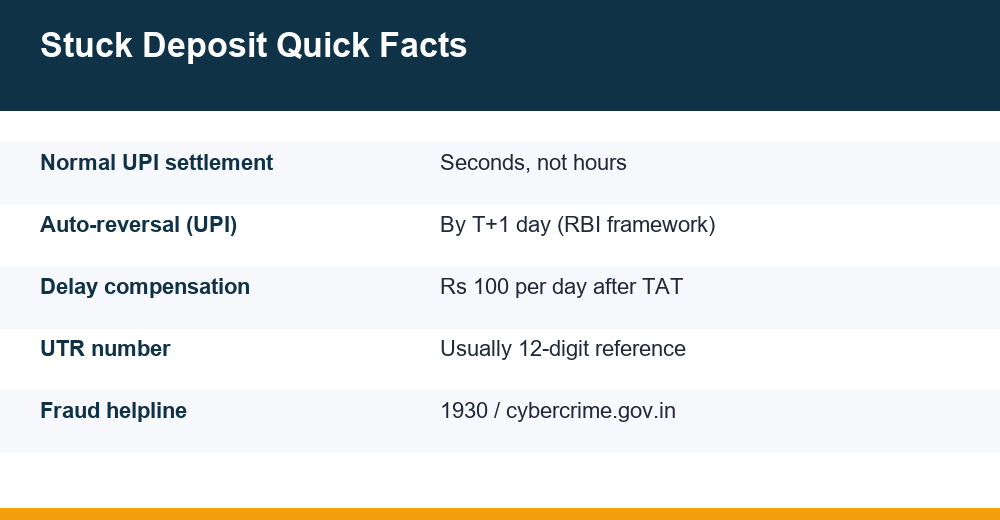
How a UPI Deposit Actually Travels
When you tap pay on a deposit screen, the money does not jump straight from your bank into your game balance. It passes through a chain of systems, and that chain has two distinct halves: a banking leg and a platform leg. Working out where the handover broke tells you who to chase, and saves you days of arguing with the wrong desk.
The banking leg is the structured part. Your UPI app sends the instruction, your bank debits the account, the NPCI switch routes the message, and the receiving bank credits the account on the other side. This leg usually completes in seconds and leaves a permanent, traceable record that both banks can look up later.
The platform leg is everything after that. A payment gateway or the platform’s own back end has to notice the incoming payment, match it to your user ID and order number, and only then update your wallet balance. That quiet matching step is where most stuck deposits die.
- Your UPI app sends the payment instruction to your bank
- Your bank debits your account and passes the transaction to the NPCI switch
- The beneficiary bank credits the receiving account
- The payment gateway tells the platform that money arrived
- The platform matches the payment to your account and credits the wallet
If the first three steps succeed, your bank’s job is finished and the debit will show as successful forever. A breakdown at step four or five is completely invisible to your bank, which is why phoning the bank first so often leads nowhere.
Deposit Not Credited: Why the Money Left Your Account Anyway
The core answer to why money was deducted but never showed up in the wallet is that the debit and the credit are two separate events. Your bank confirms the debit instantly. The wallet credit depends entirely on the platform’s systems acknowledging that payment, and several things can break in between.
Technical causes on mainstream gateways
- A gateway timeout: the payment completed after the checkout window expired, so the order was already marked failed
- A webhook failure: the gateway’s confirmation message never reached the platform’s server
- An order mismatch: the payment arrived but could not be tied to your user ID or order number
- A pending banking status: the transaction sits in limbo between banks before being confirmed or reversed
- A manual review queue: unusually large or repeated deposits held back for checks before crediting
These cases usually clear on their own or after a single support ticket, because the money is sitting in a traceable corporate account and the platform has every reason to credit it rather than argue.
Causes that point somewhere darker
On anonymous colour-prediction apps, a deposit not credited can be the business model rather than a bug. Some of these apps collect money through personal UPI handles or QR codes that rotate every few hours instead of a proper merchant account. Money paid that way lands in an individual’s account, and no automated system exists to credit your wallet at all.
When the receiving side is a personal account, support can simply assert the payment never arrived, and there is no gateway record to point at. That is why the difference between a merchant-route deposit and a person-to-person transfer matters.
How Long Does a UPI Payment Take to Reflect?
A normal UPI transaction settles in seconds. If your deposit has not appeared within a minute or two, something in the chain has stalled, but that alone does not mean the money is gone.
UPI transactions carry one of three statuses: success, failed, or pending. Pending means one bank has not yet confirmed its side. Such payments are worked out in the background and either complete or reverse, often within hours and at the outside by the next working day.
Platforms then add their own buffer on top. Many gaming and prediction apps state that deposits can take 10 to 30 minutes to reflect during busy periods. Treat such figures as illustrative; the banking leg itself is near-instant, and long platform-side delays on every deposit are themselves a quality signal.
- Under 1 minute: normal, no action needed
- Up to a few hours: wait if the status shows pending, and do not pay again
- By end of next working day: the outer limit for automatic reversal of a failed debit
- Beyond that: raise a formal complaint and start the escalation path
One practical habit matters more than all of this: never repeat a payment while the first one still shows pending. Users chasing a stuck deposit often send the same amount two or three more times, multiplying the money at risk for the sake of a balance that may well appear on its own.
It is worth remembering what the balance is for. These are chance-based products with a built-in house edge, real money is at risk on every round, and they are strictly for adults aged 18 and over. A payment delay is a reason to pause, not a reason to top up twice.
The UTR Number, Explained
The UTR, or Unique Transaction Reference, is the number generated for a UPI payment so the banking system can identify it. For UPI it is usually a 12-digit figure. It is the payment’s fingerprint: both banks, the NPCI switch and any mainstream gateway can locate the exact transaction from it. Without a UTR, a complaint is a story. With one, it is a traceable record.
Where to find it
- Google Pay: open the transaction and look for the UPI transaction ID in the details
- PhonePe: tap the payment in history; the reference appears in the detail view
- Paytm: open the transaction detail page and check the UPI reference number
- Bank statement: the reference usually appears in the narration line of the debit entry
- Bank SMS alert: many banks include the reference in the debit message itself
Labels vary between apps, which trips up a lot of complaints. You may see UTR, UPI reference number, transaction reference number or bank transaction ID, and sources disagree on whether an app’s alphanumeric transaction ID is the same thing as the numeric reference. The safest move is to save every reference the app shows you, then supply whichever one the bank or support desk asks for.
A real payment team can confirm receipt against a valid reference within minutes, because that is exactly what reconciliation tools are for. A desk that keeps requesting the same reference for days, or insists it cannot trace a valid one, is telling you something about the operation it belongs to.
When Your Bank Must Reverse a Failed Transfer
Failed UPI debits do come back, and the timelines are published rather than a matter of goodwill. The Reserve Bank of India’s framework on turnaround time and customer compensation for failed transactions, in force since October 2019, sets outer limits for authorised payment systems, UPI included.
The headline scenario is exactly the stuck-deposit one: your account was debited, but the beneficiary account was not credited. In that case the transaction is to be auto-reversed, and where the reversal runs late, compensation of Rs 100 per day of delay applies. The framework also says such compensation is to be credited without waiting for you to claim it.
| Scenario | Outer limit in the RBI framework | If it runs late |
|---|---|---|
| UPI debited, beneficiary not credited | Auto-reversal by T+1 (next day) | Rs 100 per day of delay |
| UPI merchant payment, no confirmation to merchant | Credit adjustment within T+5 days | Rs 100 per day beyond T+5 |
| Transaction stuck as pending | Resolved to success or reversal in the same window | Same compensation basis |
T means the transaction date, so a genuinely failed Monday deposit should bounce back by Tuesday on its own. The RBI describes these windows as the outer limit for resolution, so faster is expected and slower is the exception that triggers compensation.
Here is the catch for gaming deposits. If the banking leg succeeded, the beneficiary account was credited, and the reversal path does not apply at all. The bank delivered the money; the platform simply never passed it into your wallet. That is why checking the payment status and reference matters before you blame the bank.
A deposit not credited despite a successful banking leg is therefore a platform dispute, not a banking failure, and the pressure points change completely.
What Proof to Save When a Deposit Goes Missing
Whether this ends in a quiet wallet credit, a bank reversal or a fraud complaint, the evidence you capture in the first hour decides how strong your case is later. Chat histories get cleared by the platform, so save everything to your own device straight away.
- Payment screenshot showing amount, date, time, status and the UTR or reference number
- The bank SMS or statement entry showing the debit
- The deposit screen or order page on the platform, including the order ID
- The receiving UPI handle, account name or QR code the money went to
- Every support chat, email and ticket number, with timestamps
- Your wallet balance before and after the payment, if you can capture both
The receiving handle deserves special attention. If it belongs to an individual name rather than a registered business, that single screenshot can later become the centrepiece of a fraud report. Investigators can trace where money travelled far more easily when the complaint carries the exact beneficiary details.
Keep the originals rather than copies pasted into a support chat, and export them off the app if you can. If things escalate, the process for reporting online gaming fraud through official channels asks for precisely these items, and a complaint filed with a complete evidence set moves far faster than one rebuilt from memory weeks later.
One more quiet habit: log a deposit not credited incident even when the platform eventually fixes it. A pattern of repeated credit failures on the same app is itself evidence, and it should feed into whether you keep any balance sitting there at all.
What to Put in Your First Support Ticket
Most stuck deposits are resolved or refused on the strength of the first message you send. A vague complaint invites a template reply; a complete one forces a real lookup, so a deposit not credited ticket should lead with the reference number and the exact amount.
- Open with one sentence stating the amount, the date and the exact time of the payment
- Give the UTR or UPI reference number, then the platform’s own order ID if you have it
- Name the receiving UPI handle or account the money went to
- State your registered username, phone number or player ID exactly as the account shows it
- Attach the payment screenshot and the bank debit message
- Ask one direct question: has this reference been received, and when will the wallet be credited?
- Request a ticket number and a stated resolution date in writing
| Reply you receive | What it usually means | Sensible next move |
|---|---|---|
| Payment traced, crediting shortly | Platform-side matching failed and has now been fixed | Hold them to the stated date, keep the ticket number |
| No record of this reference | Either a genuine reconciliation gap or a personal-account route | Check the payment status in your UPI app, then escalate |
| Pay again to release the stuck amount | A demand with no legitimate basis | Stop paying and treat it as suspected fraud |
| Silence past the stated date | The ticket is not being worked | Move to the bank, app dispute and official channels |
No reply pattern proves bad intent by itself. But a request for a second payment to free the first one is never a normal part of any payment system, and it should end the conversation rather than continue it.
Delay or Scam? Red Flags That Change the Picture
Most stuck deposits on mainstream gateways are plain delays. On anonymous prediction apps, the balance of probability shifts. No single sign proves bad intent, and no named platform deserves a verdict on one incident, but these patterns should change how you respond.
- Deposits collected on personal UPI handles or QR codes that change every few hours
- Support that answers instantly before payment and goes quiet afterwards
- Pressure to pay again to unlock, verify or release the first stuck deposit
- A deposit that credits only after you complain publicly, with no explanation offered
- Deposits that always work, while cash-outs always stall
- No traceable company name, address or payment partner anywhere in the app
That fifth pattern is the most telling of all. Platforms built to extract money usually credit deposits flawlessly, because deposits feed the machine, while cash-outs meet endless verification hurdles. If your money flies in but crawls out, read how withdrawals on colour-prediction apps are supposed to work, and what it means when a withdrawal gets blocked right after a large win.
Remember what these games are underneath. Outcomes are pure chance with a built-in house edge, so across enough rounds the platform keeps a margin on everything staked. A deposit that vanishes before you even play simply moves the loss earlier in the sequence.
If the evidence points to deliberate non-crediting, stop depositing and treat it as suspected payment fraud. Call the national cyber fraud helpline 1930 as soon as you can and file a complaint at cybercrime.gov.in; speed genuinely matters, because fast reporting improves the chance of money being frozen before it moves on.
The Escalation Path, Step by Step
When the waiting is over and the wallet is still empty, work through the channels in order. Each step produces a reference number that strengthens the next one, so skip nothing and write everything down as you go.
- Platform support first: raise a ticket with the reference, amount, date, time and order ID, then note the ticket number and the resolution window they state
- Your UPI app: open the transaction in history and use the raise concern or dispute option, which logs the case inside the official UPI dispute system
- Your bank: if the transaction shows failed while the debit still stands beyond the next working day, complain to the bank and cite the RBI turnaround-time and compensation framework
- NPCI dispute redressal: if the app and the bank both stall, escalate through the NPCI’s UPI dispute redressal mechanism on its official portal
- RBI ombudsman scheme: for unresolved bank-side failures, this is the final free escalation step and it costs you nothing to use
- Fraud route: where the platform itself is the problem, call 1930 and file at cybercrime.gov.in with your full evidence set
Notice the fork in that path. A failed banking leg is a bank matter with published deadlines working in your favour. A successful banking leg with a deposit not credited to the wallet is a platform matter, and the pressure points are support tickets, the gateway and ultimately an official fraud complaint.
A closing word of perspective. A payment system can return a stuck deposit, but nothing returns money lost to the games themselves. These are chance-based products for adults 18 and over, and every rupee deposited is genuinely at risk. If chasing deposits has become a routine part of your week, that is the clearest signal of all to step back; free, confidential support is available through Tele-MANAS on 14416 for anyone finding it hard to stop.
Frequently Asked Questions
Why was money deducted but not credited to my game wallet?
Because the bank debit and the wallet credit are separate events. Your bank completed its leg, but the platform’s system failed to match the incoming payment to your account, usually through a gateway timeout, a missed confirmation message or an order mismatch. On apps collecting money through personal UPI handles, no automatic crediting system may exist at all.
How long does a UPI deposit take to reflect?
Normally seconds. A pending transaction can take a few hours while the banks confirm it, and a genuinely failed debit should auto-reverse by the next working day under the RBI turnaround-time framework. Platform-side crediting may add minutes in busy periods. If nothing has changed after one working day, stop waiting and start the complaint path.
What is a UTR number and where do I find it?
The UTR is the Unique Transaction Reference generated for a payment, usually 12 digits for UPI. Find it in your payment app’s transaction details, in the narration line of your bank statement, or in the bank’s debit SMS. It lets banks and gateways trace the exact payment, so quote it in every complaint with the amount, date and time.
Can my bank reverse a failed deposit?
Yes, when the banking leg actually failed. Under the RBI turnaround-time framework, a UPI debit where the beneficiary was not credited should auto-reverse by the next day, with Rs 100 per day compensation where that runs late. If the receiving account was credited, the bank’s part is done and the dispute shifts to the platform instead.