A colour prediction scam rarely feels like a scam at the beginning — it feels like a simple game that actually pays. That is by design: these operations follow a rehearsed, stage-by-stage playbook built to earn trust before draining money. This breakdown maps all seven stages, so you can recognise exactly where you are in the pattern and step out early.
Table of Contents
How a Colour Prediction Scam Is Built
Colour prediction platforms ask users to stake real money on the outcome of a short timed round — usually red, green or violet, sometimes a number. The result is produced on the operator’s server, out of your sight. Every round is a chance event with a built-in house edge, real money is at risk, and this material is written for adults 18+ only.
The fraudulent versions go far beyond an unfavourable edge. Security researchers at CloudSEK who tracked these operations documented around 60 near-identical websites promoted through hundreds of social media handles, using domain names stuffed with words like mall, game and club so the network survives individual takedowns. Most of these apps never appear on official app stores; they circulate as direct APK links and website addresses pasted into chat groups.
Almost every colour prediction scam that victims later describe follows the same seven-stage arc. The names change, the logos change, the colours on the wheel change, but the sequence stays remarkably stable. Here is the whole pattern at a glance.
| Stage | What happens | Your warning sign |
|---|---|---|
| 1. Recruitment | Invite links, earning screenshots, group adds | Strangers pushing you to join fast |
| 2. Early wins | Small stakes win, a tiny payout goes through | Winning feels suspiciously easy |
| 3. Escalation | A ‘mentor’ pushes bigger deposits | Minimum amounts keep climbing |
| 4. The turn | Losses quietly replace wins | The ‘expert tips’ suddenly fail |
| 5. Blocked wallet | Withdrawal stuck as pending or rejected | New conditions appear from nowhere |
| 6. Unlock fees | Tax, verification or VIP charges demanded | You must pay to get your own money |
| 7. Vanishing act | Domain changes, support goes silent | App or site simply stops loading |
Two details are worth holding on to before the detail. First, the stages are sequenced to build belief before they extract money, which is why the early experience is deliberately pleasant. Second, nothing in the sequence depends on your skill, your timing or your luck — it runs the same way for everybody, because the operator is writing the script on both sides.
The sections below walk through each stage — how it works, why it works, and the exact moment to stop.
Stage 1: Recruitment Through Social Media and Telegram
The first contact almost never comes from the app itself. It comes from a person or a post: a reel about easy daily earnings, a video promotion, a WhatsApp forward from an acquaintance, or an unsolicited add into a Telegram earning group.
Inside those groups, admins post a steady stream of screenshots — wallet balances, payout confirmations, car and phone purchases. Such screenshots are trivially easy to fabricate or recycle, yet in volume they create a powerful impression that everybody around you is profiting. We have unpacked how these channels actually operate in our breakdown of what happens inside Telegram prediction groups.
Recruitment leans on a small set of repeatable hooks:
- Referral commissions — existing members earn a cut of your deposits, so victims become recruiters
- A personal ‘teacher’ or ‘mentor’ who messages you directly and offers free winning signals
- Short-expiry joining bonuses that pressure you to register within minutes
- Claims that the game is backed by a famous company or celebrity, with no verifiable proof
- Posts that name a specific daily income figure, as if earnings were a salary rather than a gamble
Who these groups look for
Recruiters favour people under financial pressure and people new to online payments: students, first-job earners, homemakers, gig workers, anyone searching for part-time income. The pitch is adapted to each — pocket money, side income, a way to clear a loan. None of it changes the arithmetic of the game underneath.
Notice what is absent at this stage: any neutral information about who runs the platform, where it operates from, or how results are generated. If the only voices vouching for an app are people paid to recruit for it, that silence is the first red flag.
Stage 2: Why the App Lets You Win at First
New users are often surprised by how well things start. You deposit a small amount, follow the group’s predictions, and win more rounds than you lose. Then comes the masterstroke: you request a small withdrawal, and it arrives in your bank account quickly.
That early payout is the single most persuasive moment in the entire operation. It converts scepticism into confidence. Victims later say the same thing almost word for word — the app felt genuine because it paid.
The engineered win
Remember where the result comes from. A platform that generates outcomes on its own server can let small accounts win for as long as it likes. Paying you a few hundred rupees now is simply the operator’s marketing cost — spent to unlock the thousands you may deposit later.
The displayed balance deserves the same scepticism. Numbers on the screen are just numbers the operator chose to show you; they become money only if a withdrawal actually settles in your bank. Treat the app’s figures as a claim, not a statement of account.
A quick early payout therefore proves nothing about a platform’s honesty. It is equally consistent with a fraudulent operation warming you up. The meaningful test — a large withdrawal after large deposits — is precisely the one these platforms are built to fail.
Stage 3: Deposit Escalation and the Mentor Trap
Once trust is established, the pressure to deposit more begins. The mentor’s tone shifts from friendly to urgent: bigger opportunities need bigger stakes, VIP tiers promise better returns, and special ‘merged orders’ or ‘tasks’ supposedly multiply your money — but only above a minimum amount.
This is the stage where a colour prediction scam moves from pocket change to serious harm. Victims describe draining savings, borrowing from relatives, even taking instant app loans to meet the next deposit threshold. Each payment is framed as the last step before a big release.
Common escalation scripts include:
- ‘Your level only allows small profits — upgrade to VIP to earn properly’
- ‘Today’s prediction is 100% confirmed, but the minimum stake is higher’
- ‘Complete three more tasks and your bonus will be released’
- ‘Deposit before the timer ends or you lose your slot’
- ‘You are so close now — one more round recovers everything’
Why the amounts always climb
Escalation is not improvised; it is the point. Each step is sized just above what you have already risked, so the next deposit feels like a small extension of a decision you have already made rather than a fresh one. The sunk-cost feeling does the persuading, and the mentor only has to supply a deadline.
Payment problems often begin here too. Deposits are collected through rotating UPI handles and personal accounts rather than a stable payment gateway, so money sometimes leaves your bank without ever reaching the game wallet. If that has happened to you, read our step-by-step process for tracing a deposit that was never credited before you pay anything again.
Stage 4: The Turn, When Losses Replace Wins
At some point — usually soon after your deposits get serious — the winning stops. The mentor’s signals start failing. Rounds that ‘could not lose’ lose. The group blames your timing, your stake size, or your failure to follow instructions exactly.
Two forces are at work. First, on a server-controlled game the operator can simply stop letting you win. Second, even without any manipulation, random rounds carrying a house edge lose money over sustained play. Either way the destination is the same.
Is any colour prediction income actually guaranteed?
No. Each round is an independent chance event, and no person, pattern chart or ‘AI predictor’ can see a server-side result before it is published. Any platform, channel or individual promising guaranteed or fixed returns from prediction rounds is making a claim that is mathematically impossible — and that promise is itself one of the most reliable markers of fraud.
The turn is also where psychology locks people in. Having lost a large sum, the instinct is to keep playing to win it back. That instinct — chasing losses — is exactly what stages five and six are designed to exploit.
If you notice yourself playing to recover rather than for entertainment, hiding the activity from family, or using borrowed money, treat that as the signal to stop rather than as a phase to push through. Free, confidential support exists, and the helpline details are in the final section.
Stage 5: The Blocked Wallet and Withdrawal Excuses
Eventually you decide to take out what remains. Small amounts may still go through, but a large withdrawal meets the wall. The request sits as pending for days, then fails or is rejected with a vague reason.
Victims report a familiar menu of excuses:
- ‘Suspicious activity detected — account under review’
- ‘Verification required before payout’
- ‘Bank details mismatch — contact your agent’
- ‘Server maintenance — try again after 72 hours’
- ‘Invite new members to activate your withdrawal’
- ‘Your turnover target is incomplete, keep playing’
On a legitimate platform a payout can be delayed for mundane reasons — name mismatches, verification holds, bank-side processing windows. We explain what each status normally means in our plain-language look at how colour prediction withdrawals are supposed to work.
The asymmetry that gives it away
The difference in a fraudulent operation is the direction of friction. Deposits are accepted instantly, around the clock, with helpful support if anything goes wrong. Withdrawals meet an endless rotation of new conditions, each one invented after you asked. When money flows one way without obstacle and hits a wall in the other, the wall is the business model, not a technical fault.
A second tell is the turnover or ‘wagering’ requirement that appears only at this point. If a condition on your own balance was never shown before you deposited, it was not a rule — it was an exit being built.
Stage 6: Unlock Fees, a Second Scam Inside the First
Stage six is where the operation squeezes its most committed users. Support — or the mentor — explains that your blocked balance can be released if you pay one more charge. Only the label varies.
- Income tax or ‘clearance’ charge on your winnings
- KYC or verification processing fee
- VIP or account-upgrade payment
- Wallet activation or reactivation deposit
- Refundable ‘insurance’ or security deposit
- Currency conversion or gateway handling fee
Why the app demands another deposit before paying out
The logic sounds almost official, and the displayed balance — often inflated by winnings that were never real — makes the fee look trivial by comparison. Paying a few thousand rupees to unlock a figure many times larger feels rational. But that larger figure is a number on a screen controlled by the same people asking for the fee.
No genuine platform anywhere asks you to send a separate payment in order to receive your own withdrawal. Real charges, where they exist, are deducted from the payout itself. A pay-to-withdraw demand is not a step in a process; it is a second scam built on top of the first.
Each fee you pay also marks you as someone who pays, so another follows — tax after verification, processing after tax, a final ‘release’ charge after that. Some victims lose more at this stage than in the game itself. Whatever the balance on screen says, the correct amount to send is zero.
Stage 7: The Vanishing Act and Changing Addresses
The final stage is silence. The mentor stops replying, the group is deleted or you are removed from it, and one day the app or website simply does not load. Sometimes a ‘new official link’ circulates first — the same clone under a fresh name, harvesting a fresh wave of users.
Why these apps keep changing their website address
Frequent domain hopping serves the operators in several ways: it sheds complaints and blacklists attached to the old address, breaks the links cited in victim reports, and lets the same reused code relaunch under a new brand within days. For users, a platform that has already changed its address repeatedly is announcing in advance that it expects to disappear.
Recognising a relaunch is easier than it sounds. Watch for an identical interface under a new name, the same admin accounts promoting it, invite codes carried over from the old group, and a brand with no history older than a few weeks.
Where the deposited money actually goes
Money paid into these platforms is typically moved out fast — passed through chains of mule bank accounts and payment handles so it becomes hard to trace. Recovery is never guaranteed and depends heavily on how quickly the fraud is reported, because banks can only attempt to freeze funds still sitting in a traceable account. That urgency is exactly why the reporting steps below matter.
One last red flag belongs here: anyone who contacts you after the collapse promising to recover your losses for a fee is running the next scam in the chain, often using victim lists leaked from the first.
What to Do at Any Stage: Evidence, Reporting and Support
You do not need to wait for stage seven to act. The moment you recognise the pattern, stop all payments — including any unlock fee — and switch from playing to documenting.
- Preserve evidence: screenshot your wallet balance, withdrawal requests, chat conversations, payment confirmations with UTR numbers, and the app or website address
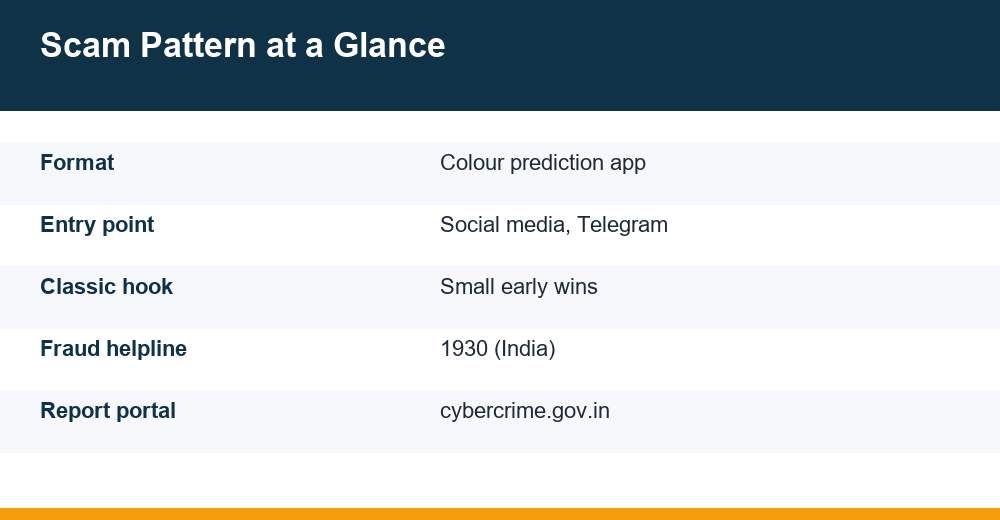
- Call the national cyber fraud helpline 1930 as soon as possible — early reporting gives banks the best chance of freezing funds still in transit
- File a written complaint on the government portal cybercrime.gov.in and attach your evidence
- Inform your bank and UPI app about the fraudulent transactions and ask for their dispute process in writing
- Keep the acknowledgement number from every call and complaint so you can follow up
- Ignore ‘recovery agents’ who promise to get your money back for a fee — that is a follow-up scam aimed at known victims
Reporting a colour prediction scam also protects the next person: the numbers, UPI handles and website addresses you submit feed the systems used to flag and block them.
A short checklist before you ever deposit
- The platform is not on an official app store and arrives only as a shared APK or link
- Nobody can tell you who operates it or how results are generated
- Payments go to rotating personal UPI handles rather than a stable gateway
- Someone is promising guaranteed, fixed or daily returns
- Your contact earns a commission on your deposits
- The brand or domain is only weeks old, or has already changed once
Finally, be honest with yourself about the toll. Losing money this way commonly brings shame, anxiety and sleepless nights, and many people hide it from family for months. Confidential support exists: Tele-MANAS, India’s national tele-mental-health service under the Ministry of Health and Family Welfare, is available 24×7 on 14416 (or 1-800-891-4416) in a choice of languages. Talking to someone is a step forward, not an admission of failure.
Frequently Asked Questions
How do colour prediction apps scam users?
A colour prediction scam works in stages: recruitment through social media and Telegram, engineered early wins with one small successful payout, escalating deposit demands from a ‘mentor’, then sudden losses, a blocked wallet, invented unlock fees and finally a vanished platform. Because results are generated on the operator’s own server, every part of that experience can be controlled from the other side.
Why do colour prediction apps let you win at first?
Early wins are a marketing cost. The operator controls server-side results, so letting a new user win small amounts, and processing one quick withdrawal, converts doubt into confidence. That confidence is what unlocks much larger deposits later. A fast early payout proves nothing about honesty; the real test is a large withdrawal, which these platforms are built to block.
Are colour prediction earnings guaranteed?
No. Every round is an independent chance event with a built-in house edge, so sustained play loses money over time even on an honest platform. No pattern chart, Telegram signal or ‘AI predictor’ can read a server-side result in advance. Any promise of guaranteed or fixed returns is mathematically impossible and is itself a strong indicator of fraud.
What happens to money deposited in a scam prediction app?
Deposits are usually moved out quickly through chains of mule bank accounts and rotating UPI handles, which makes the money hard to trace. Recovery is never guaranteed and depends on speed: call 1930 and file on cybercrime.gov.in immediately, because banks can only try to freeze funds that are still sitting in a traceable account.